Saturday, January 3, 2015

Christian Peters - one of many family soldiers

(Family lineage:  Brother of Elizabeth Peters, 1  Charles Walker, Jr  2.  Eliza Frances Walker 3,   Emarine Bartram 4, 
Queen Rebecca Dickerson  5,  Edna Bethel Franklin  6 ,  Judith Ann Hayward  7 )

1760 - 1837 

Since researching and writing about the Revolutionary soldier, John Copeland, I've discovered that the Copelands, Philpotts and Nances created several new branches on their family trees through intermarriage.  At the same time, the  Walkers, Callaways and Peters not only intermarried but - after fighting in the Revolution - packed up their families and moved together to Peterstown in New River, Virginia. 

Until now, only the Peters women who had married Walker men early in our country's history have been mentioned in family legends about their husbands/brothers/sons.  So now it's time to concentrate on the Peters men whose parents had migrated from Germany in 1737 and settled in Virginia where they raised their family.  Three of their sons (John, Christian and Jacob) fought with distinction in the Revolution; but for no good reason, I decided to focus on Christian who, at age 19, was finally old enough to join the fight four years after it began in 1775. 


Christian's involvement began when the Governor of South Carolina offered 1,000 pounds of tobacco ($33.33) to any man volunteering to fight with the militia against marauding Indians attacking settlers along the South Carolina/North Carolina border. 
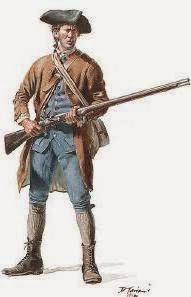
Although he was a Virginia boy, Christian seized the opportunity to get paid while experiencing adventure away from home and hearth.  Grabbing his rifle, tomahawk and butcher knife, he joined his brothers and fellow Virginians in the fight and attained the rank of Corporal.  

It wasn't long, however, before his militia was absorbed into the "Virginia Line" which - with militias from the 12 other colonies -  fell under the umbrella of the Continental Army. This action was especially important to commissioned officers under the rank of Brigadier General who, before that time, couldn't be promoted except in their particular colony's  line.

Christian, known by this time as an expert marksman, quickly rose to the rank of Sergeant and was heavily involved in some of the more famous southern battles, including Cowpens on the South Carolina/North Carolina line, Hot Water, Jamestown and eventually Yorktown.  

Col. Daniel Morgan
Under the leadership of  Colonel Daniel Morgan, the infamous Lieutenant Colonel Banastre Tarleton and his 1,000 troops were defeated at Cowpens, which led to 600 British soldiers being captured.  During the battle, most of the Virginia men, including Christian, depended on  their personal long rifles, with which they shot down so many British officers that proper control of the British line was destroyed.  

 After helping to deliver those British prisoners, Christian received his discharge papers and a bounty for his service, which he traded to another soldier for a horse. It was a good deal for them both.  Christian could now get around on horseback instead of by foot and the former horse owner could return home with a little money and  an official discharge - even if it took a little longer to get there.

Now that he was officially back in the war, Sgt. Christian Peters  traveled with his
General "Mad" Anthony Wayne
regiment to Hot Water, six miles from Williamsburg, Va.  The hard-fought battle, which lasted only two hours and ten minutes, didn't go well.  The Americans were soundly defeated, which forced the survivors to fall back to Jamestown, where they joined General "Mad" Anthony Wayne's regiment in another bloody battle.  Luckily for Christian, he was assigned a position in an area far less dangerous and came out of the battle unscathed.  

Finally, in 1781, he re-connected with his brother, John, and brother-in-law, Charles Walker, in Yorktown where they participated in the battle and witnessed Cornwallis' surrender which finally brought an end to the long devastating war. 


Amazingly, the Peters, Walker and Callaway families came through the war pretty much intact and after being awarded bounties for their service, decided to build their post-war lives on New River, a tributary of the Kanawha River, in the Appalachian Mountains of Virginia.  In 1785, Christian married his sweetheart, Anna Catherine Fudge who had only been 13 years old when he had left for war, and with whom he had nine children.  

As the years went by, Christian, a man of energy and drive, built a home which stood for many years. Among his enterprises were the building of the first grist mills in the community.  These mills would be considered very crude and rough affairs in today's world but of course they were built on the technology existing at the time and served their purpose.


Christian was awarded a pension for service to his country in 1833 and died four years later at age 77. In honor of his service, the U.S. Government furnished a war memorial tablet which was placed on his grave and unveiled with great ceremony.  


http://www.Virginia Militia in the Revolutionary War:McAllister's Data
http://www.wvculture.org/history/agrext/peters1.html
http://www.wvculture.org/history/agrext/peters20.html
http://www.wvculture.org/history/agrext/peters21.html
http://www.shgresources.com/wv/counties/monroe/
http://ftp.rootsweb.com/pub/usgenweb/wv/monroe/bios/peters1.txt

Friday, December 19, 2014

Mae Walton Finn, a wild Irish rose

Mae Walton Finn 1, Charles Thomas Copeland, Jr. 2

1914 - 1988


My mother-in-law would have been shocked that she is considered a family legend well worth writing about. That belief, which evolved over the years, was based on conversations, stories told by family members and facts gathered from her papers after she died.  

Her legend had its roots in the British Isles years before her birth when: 

 
In the late 1800s, her grandfather, Jacob Walton,  sailed from England to America, where he met Mary "Mattie" Mae MacFarlane, whose parents had migrated from Scotland and settled in Manitowac, Wisconsin.  Shortly before their marriage in 1886, he returned to England, where he convinced his brother, Robert, (who later died in a train crash) and sister, Elizabeth, to come back to America with him where they could live with the newly married couple in Chicago (hopefully with Mattie's blessing).

 
The extended family established their home on the south side of Chicago, where they eventually opened a candy store and raised  Bessie (born in 1891) and Wallace "Wally" (born in 1893).
  • In 1901, Joseph Eugene Finn, who had grown up in Galway, Ireland with 12 siblings, joined his widowed mother, brothers and sisters in Boston.  But Joe was restless and eventually headed west, not stopping until he arrived in Chicago, where he met and married 22 year old Bessie Walton in 1913.
========================================
Mae Finn was born on September 6, 1914 and her family's seemingly normal life changed dramatically when:
  • Joe and Bessie's marriage broke up, resulting in the 3 year old and her mother moving back to live with Bessie's parents.
  • A year or so later, Bessie married Philip Costa.  It didn't take long for her to realize that their marriage  had been a big mistake.  It is suspected there was physical abuse, but the only thing known for sure is that Bessie moved back home with her now 5 year old daughter, where she helped out in the candy store and Mae attended kindergarten in the school across the street.
  • Seemingly Phillip could not or would not accept Bessie's decision to end their marriage.  In an attempt to convince her that he'd changed and was willing to do anything to get his family back, he often would appear at the store. It all came to a head on December 6, 1919 when, after she had refused his pleas once again, his frustration boiled over and he shot her, immediately fleeing the candy store where she laid dying. To this day, it is not known whether he was ever caught and tried. 
10 year old Mae

Following Bessie's death, Mae became a permanent resident in the Walton household  composed of her grandparents, Great Aunt Elizabeth, and  Uncle Wally.  She found it less complicated to simply tell people that her last name was Walton, although her father, Joe Finn, who never remarried and claimed he was a widower, did remain active in her life until his death in 1958.
 
The Waltons provided Mae with a stable but strict home.  At age 16, after finishing her sophomore year in  high school, she entered "secretarial school", where she learned what it took to be successful in an office environment and found that her typing skills were particularly good. 

Her eighteenth year was filled with unexpected joys and sorrows.  Two months after her birthday, her grandfather who had closed his candy store and returned to work in a cement factory, died. This of course meant that it was even more important that Mae use her typing skills to help support her grandmother and the family.
 
When she wasn't working, she was spending a lot of time  roller skating at a nearby roller rink. While she thoroughly enjoyed the smoothness and grace of dancing on skates, she also loved to compete with other skaters in rough and tumble games on wheels. 

At that time a new sport called "roller derby" was being created and organized, which strongly appealed to Mae.  To her delight, after auditioning, she was accepted to be on one of the newly formed  teams.  However, her excitement was short-lived when the adults she loved and respected convinced her that leaving a steady job which supported her family for a dream could end in disaster - both physically and financially.
Tom and Mae Copeland - 1935

That year also brought  unexpected happiness when the 18 year old fiery redhead met Tom Copeland, a handsome 31 year old Georgian who shared not only her love of skating but whose birthday was also on September 6.  

Mattie Walton and Joseph Finn


As time passed, the couple not only shared a love for skating, but discovered that their shared interests had expanded into other parts of their lives.  On September 6, 1935, 20 year old Mae and 33 year old Charles Thomas "Tom" Copeland celebrated their birthdays in a wedding ceremony, with Mattie Walton and Joe Finn serving as parents of the bride.

 
Even after their son and daughter were born, they continued to dance and skate whenever possible with the "Old Timers Roller Skating Club"  until their bodies started complaining.


There's no doubt that the tragedies that had been woven into her life before she could even talk, affected how she often responded to perceived threats in her later years. 

However, there was the happy child side of her  who loved to play and have fun. The stories of those entertaining times are many and include:
  • Grabbing her young son and chasing fire trucks;
  • Racing around the roller skating rink floor and bouncing the bouncers who tried to slow her down (much to her child's embarrassment);
  • Agreeing to attend a college football game without knowing a thing about the game so she could cheer loudly for both teams - no matter what happened;
  • Turning off all the lights, changing her voice and telling incredibly scary bedtime stories to her grandsons; 
 After 43 years of marriage, Tom died and Mae grieved for him until she finally joined him ten years later.   A legendary life indeed!


Saturday, November 29, 2014

Thomas Ward Custer - George Custer's brother who fought and died with him

(Brother of George Armstrong Custer)

1845 – 1876

Unless one has an extraordinary amount of time and patience, many of the Custer family tree twigs and branches seem impossible to untangle (and frankly, I have given up on that project for now). What we do know is that the Pennsylvania and Midwest branches sprang from Paulus Kuster, who moved his family from Crefield, Germany to America in 1682.   

Whether the name begins with a K or a C, it has recognition!  I can personally testify that upon mentioning that my great grandmother was a Custer before she married a Franklin, the immediate response is recognition of my infamous distant cousin - George Armstrong Custer.  We don't deny the relationship!  After all, it is a fact that not all fruit on any one's family tree is tasty.

George definitely qualifies as a family legend.  At first I had considered writing about this talented and forceful  man who possessed questionable decision making skills - the last one of which was responsible for the loss of  211 lives, including his own.

Emanuel and Marie Ward Custer
However, upon digging deeper into his life, I was shocked to discover that George's parents, Emanuel and Marie, actually lost three sons, a son-in-law and a young grandson on June 25, 1876 during the battle known as "Custer's Last Stand". Their only blessing was knowing that their surviving son, Nevin, would never be able to fight in a war because of his asthma and rheumatism.

The Custer casualties were:
Lt. Colonel George Custer
Libby and George Custer
  •  37 year old General George Armstrong (aka "Autie" because, as a child, he couldn't pronounce Armstrong) Custer  who fought with the Union Army.  As the War drew to a close in 1865, he  married Elizabeth (aka Libby) and then took some time off to determine whether he would have a better career outside the military. A year later, he joined the U.S. 7th Cavalry Regiment as a Lt. Colonel.  Libby traveled with him to his outposts, and defended his reputation to anyone who would listen long after his death.  Although there were rumors that he had fathered two children with a Cheyenne woman, this was never proven.
Captain Thomas Ward Custer
  • 31 year old Captain Thomas Ward Custer,  who some sources firmly say was married with children and others just as firmly disagree. He was described as a handsome, charming ladies' man, and his story is featured later in this post. 
    Boston Custer

  • 28 year old Boston Custer had been unable to join the military because of poor health, so he became a civilian contractor who served the 7th Cavalry as forage master, guide, packer and scout.
  • 18 year old grandson, Harry Armstrong “Autie” Reed, joined his Uncle Boston on the pack train which followed Custer's troops.  After hearing that ammunition was needed for the impending fight, he and Boston raced up to join the main column as it moved into position to attack a sprawling Indian village. Had they stayed with the pack train, Boston and Autie could well have survived the battle.
  •  31 year old James "Jimmy" A. Calhoun, was married to the Custers' sister, Margaret, and had served as a Second Lieutenant in the Union Army.  He was called "The Adonis of the Seventh" solely because of his handsome features.  But the truth was he was devoted to his wife and never a womanizer.  He was the Acting Commander of L Company when he was killed with most of his company, all of whom fought fiercely on what became later known as Calhoun Hill. 
Obviously they were all interesting men in their own right, but I decided to concentrate on Thomas, who was a tiger on the battlefield!  He was the only Civil War soldier to have been awarded two Congressional Medals of Honor (which he was shown wearing in the above photo). 
At age 16 in 1861, he was not allowed to enlist in the Army.  However, it was only two weeks later that he successfully lied about his age and was mustered into the 21st Regiment of the Ohio Volunteer Infantry.  During the next couple of years after taking part in a couple of skirmishes, he was assigned to escort duty on the division commander's staff and then transferred to the staff of Major General Ulysses S. Grant.

Finally, in the summer of 1864, his brother, George, obtained a commission for the 19 year old to serve as the General's aide-de-camp in the 6th Michigan Cavalry.  By 1865, the brothers had seen action in several campaigns. 

But it was at the battle at Namozine Church in Virginia that Tom, who was now a Second Lieutenant in the 6th Michigan Cavalry won his first medal when he recovered the enemy's flag.  Only a couple of days later, he charged the breastworks at Sayler's Creek and after again snatching the enemy colors, demanded their surrender.  Even though he was
badly injured and had his horse shot out from under him, he refused to give up his prize and rode off with the colors. He had to be threatened with arrest before he agreed to report to the surgeon and be treated. This action earned him his second metal.

Finally in 1866, after having mustered out of the 6th Michigan, he  received a commission in the U.S. 7th Cavalry as a first lieutenant and his career over the next several years included being wounded in 1868, serving in the Yellowstone Expedition in 1873 and the Black Hills Expedition in 1874.  In 1875, he was promoted to Captain and given command of Company C of the 7th Cavalry which was based in the Black Hills.


Only one year later, while joining his brothers, brother-in-law and nephew in a  military action on June 25, 1876 against the Sioux and Cheyenne, his life came to a violent end. The bodies of the three Custer brothers were found within yards of one another but Thomas' body was so mutilated it was only possible to identify him by means of a tattoo he was known to have had.  Initially he was buried on the battlefield but later exhumed and buried in the Fort Leavenworth National Cemetery.

George Custer's marker
 
Boston Custer's memorial


James Calhoun's memorial before fire
Autie Reed Gravestone

Wednesday, November 19, 2014

Enos Madison Philpott - the family connection to Andersonville Prison

Family lineage: Enos Philpott 1; Rebecca Philpott 2; Lula Jane Johnson 3;
; Charles Thomas Copeland Sr. 4; Charles Thomas Copeland Jr. 5

1817 - 1864

This third child of David and Sarah Philpott (featured in an earlier post) was born in Virginia, but grew up in Georgia.  It was there that he married Adaline Fuller, with whom he had 10 children.  According to census data, he and members of the Philpott family lived near each other in Troup County, just across the county line from their father's Heard County plantation.

It's possible that these tracts of farmland were deeded to the Philpott children around the time of their widowed father's marriage to Exonia Foster, in order to ensure that his adult children would receive a portion of the estate before rewriting his Will naming only his second wife and children of their marriage.

Like all families of that turbulent time, the Philpotts' life was to change forever after the Civil War began in 1860. Whatever had seemed important before that year was forgotten, and the family turned their energies to supporting the Confederacy by either joining the military or providing other services for the cause. 


Farmer Enos Madison Philpott was 47 years old in 1864 and had children ranging in age from 4 to 23.  He had chosen to contribute to the Rebel cause by raising crops and livestock to feed the troops.  But it was becoming more and more obvious as time went by that the Confederacy desperately needed  to find ways to use their manpower more effectively, thereby freeing up more soldiers from non-combatant roles to join the fight. 

Finally Enos made the tough decision to take a more active role in the war.  So he turned over the management of the farm to his wife and the oldest of his children and traveled to Atlanta, where, on April 27, 1864, he enlisted and was assigned to serve in Company C under the command of Captain Early Baker in Colonel J. H. Fannin's Georgia Reserves First Regiment. 

According to his muster records, he was 5' 10", fair complexioned, with blue eyes and dark hair. The regiment to which he was assigned was composed of students, clerks, farmers, mechanics and even a dentist. They came from 19 Georgia counties and were young boys, old men or wounded veterans who were considered not strong enough for combat but could easily fill other very necessary roles in the war effort. 

According to “U.S. Civil War Soldiers Records and Profiles,1861-1865”, Enos was assigned to be a guard in Andersonville Prison, which had  opened two months before. Its site had been chosen mostly for its remoteness and safe distance from coastal raids. Its main purpose was to house the overflow of Union prisoners who were being held in and around Richmond, Virginia until a prisoner exchange could be finalized.

It was built to hold a maximum of 10,000 captives and 1,000 guards, but was expected to decrease in size once the exchange took effect. However, after that plan fell through, the population in the prison exploded. Within a few months of its completion, Andersonville was housing 30,000 prisoners and more than 2,000 guards.


The prison was hell on earth for those imprisoned men who were given nothing for their basic needs - not clothing, food or even enough room to lie down within the vast pen. Even worse, the nearly naked prisoners suffered from swarms of insects, cold, heat, filth, and disease usually generated by what became a contaminated water supply in the creek.  Lawlessness prevailed as desperate prisoners took anything they could from weaker men in order to survive. 

We often think of prison guards as aggressive, perhaps cruel and much better off than those they guarded.  Yes, in a way these guards could have been considered better off - but not by much.  When hungry or thirsty, they could at least leave the prison occasionally to forage for food and clean water.  Remember, this  was not their chosen career, and they had been recruited from the youngest, oldest and weakest men available.  They lived in constant fear because, with no training, these almost 2,000 men were expected to detain and keep under control up to 30,000 battle tested veterans without getting beaten or killed themselves. 


Those who survived could thank the brave women living 
outside the walls who tried as much as possible to save lives, while ignoring the very real danger of spending time in a place ridden with disease and populated by desperate men.  Despite their best efforts, however, the numbers were still shocking.  The death toll by the time Andersonville was closed in April of 1865 was 13,000 prisoners and 226 guards - one of whom was Enos. 

His muster records show that he died on October 27, 1864 as a result of “disease contracted in the service of the Confederate States” (dysentery) and was buried outside the walls of a prison which had taken in its first prisoners only a few months before.

Shortly after Enos' death, General William T. Sherman captured Atlanta, which led to the transfer of the few able-bodied inmates to prisons in Savannah and South Carolina so that they wouldn't be freed to fight again for the Yankees. However, the most infirm and ill stayed in Andersonville until it closed forever.

Clara Barton
With the war finally ended in July, the U.S. government appropriated the prison's burial ground and established it as a national cemetery. A month later, the famous Civil War nurse, Clara Barton, surveyed the cemetery in order to help identify and mark the graves of the Union dead.

Finally, after three years, the Union soldiers who had been temporarily buried in the local vicinity were re-interred at the Andersonville National Cemetery. However, the graves of the Confederate guards remained outside the cemetery walls until 1878.  

We can be thankful that the women of Americus, Georgia stepped in to right that wrong. These ladies, who had been actively raising money to erect a monument in their city, identified a much more important need for that money and that was to honor those Confederate soldiers who had died while serving the Confederacy faithfully and doing the best they could during very difficult times.  These men had been lying forgotten for more than ten years - neither honored nor remembered. 

Once everyone was on board with the decision, the  donations were used to dis-inter those Confederate bodies and bury them in Oak Grove Cemetery.  If their names were known,  they would be buried in their family plots. But those whose families weren't known would be buried in an honored place where the Stars and Bars fly over the grave sites and with 43 marked as " Unknown". Enos was one of the "unknown".

His widow, Adaline, and the children continued to live in Troup County until some time before1887 when she and a few of the younger children moved to Randolph County, Alabama.  It was there that she applied for a pension under the "For Relief of Widows of Confederate Soldiers Act" and was approved in 1887, 1889 and 1891. In the applications she stated that her husband, E. M. (called Madison in the 1891 application) "was a Private in Company C of the 1st Regiment of Georgia Volunteers and that he came" to his death from disease contracted in the service of the Confederate Sates and that his death occurred during the late war; that she had not re-married, was a resident of Alabama and that her estate did not exceed $1,000 in value.  The petitions were signed with her mark and notarized.  There is no record of her life after these pension applications.

Thursday, November 6, 2014

The House that Fairbanks built - and furnished with ghosts


While researching family legends over the last several months, I discovered that there are many hidden stories out there waiting to be told - if we just dig deep enough.  Hopefully the stories written so far have been interesting and fun for you to read.  I have to admit, however, that when the thought started nipping around the edges of my consciousness that it would be fun to write about a legendary house, it was pushed out just as quickly - that is, until I started digging deeper into the story of the Fairbanks family and learned of their commitment to care for a part of their legacy which began hundreds of years ago.  


The Fairbanks House today


The legend began in 1633 when Jonathon Fairebanke (aka Fairbank, Fairbanks) migrated to America from England with his wife, Grace, and their children.  They weren't in their new country very long before they decided to settle in Dedham, Massachusetts and build a house for their large family.  The construction of the building took over a year to complete, and the family lived in a small house situated on the property until the first livable phase was completed in 1636.

They would no doubt have been shocked to learn that for almost 400 years, their home was continuously occupied by their lineal descendants - until it was converted into a museum still managed and tended by the Fairbanks family.  Perhaps just as remarkable is that there has never been a mortgage encumbrance upon it. 

Although it is generally accepted that the house was built in 1636, there has been considerable disagreement among historians about its construction.  One of these historians believes that it was not built until 1654, based on the “fact” that while the old house is a framed building of massive oak timber, there is no historical evidence that any framed houses were erected in the town at that time. 

A strong argument against this alleged ”fact” is the established tradition that  the frame for the main part of the house, as well as the bricks, tiles and windows, had been imported from England to Boston, where they were stored for several months before being transported to Dedham.


This very old house stood tall through the bloody birth of America, and continued to house its family while our country's history was being played out through the  centuries. 
But that's not the end of the story, and this next  chapter makes it even more intriguing. Because of  paranormal activity claims made by the staff and visitors (hearing children laughing when none are in the house and disembodied footsteps which have no apparent explanation), the house now carries the title of "The Nation's Oldest Haunted House"!

Finally, after the management of the museum continued to hear these odd stories from more than one person, they hired The Atlantic Paranormal Society (aka TAPS), a group of “ghost hunters”, to investigate.

After arriving at the site and interviewing the staff, TAPS made arrangements to stay in the house all night  in order to make audio recordings.


Fairbanks House parlor
One of the museum's employees, who is also a member of the Fairbanks family, joined the TAPS team in the house's tiny parlor that night and admitted that he got little or no sleep - especially when his cell phone went off in the middle of the night and began playing organ music! 

After reviewing those tapes the next day, the team  identified sounds that they identified as laughing kids.  Even the employee who had spent the night with them admitted that he too had heard the sounds.  He became a little calmer about the incident when the ghost hunters assured him that if there were spirits in the house, they were likely members of his own family and wouldn’t harm him. The TAPS team also told him spirits like to ‘mess with electronics,’ which might explain why tourists cameras often stop working when in the house.

The TAPS group returned for a second round of testing, this time armed with their elector-magnetic field detectors and audio recorders. The team leader described the outing as “awesome” and made an official report which said, in part, that "the house had a very different feeling the second time" and that there had been "lots of knocking and moving sounds".  She  stated that she and her team now firmly believe there is paranormal activity in the house.
This report was, not surprisingly, questioned by more than one observer, who claimed that most paranormal groups don't properly investigate and analyze the data that has been collected.
Despite those reservations, however, there are others who firmly believe that the house is populated by “strange spirits” and could well be one of the “most haunted houses in America”. One of theose believers is a museum director whose ancestors built the property:


"There’s always been weird things happening in the house, from the doorbell going off a million times to flashlights never working. . . there are sometimes footsteps heard on the stairs when no one is there. Also, a newly-installed alarm system went off every night for several weeks with the alarm company unable to offer an explanation.”

It's natural to assume that  if you have ghosts
haunting a house, there had to have been some violent deaths in it. Therefore, you might not be surprised to learn that there was at least one such death which was reported in 1801, when one of the Fairbanks sons, 21 year old Jason, was convicted of killing his girlfriend, Elizabeth Fales, in a nearby pasture. She had apparently spurned his marriage proposal.  He was hanged from the gallows on Dedham Common in one of the most sensational murder cases of the time. A few months after the hanging, Jason's older brother Ebenezer published an expensive booklet entitled "The Solemn Declaration of the Late Unfortunate Jason Fairbanks", in which he proclaimed Jason's
innocence.

Hopefully the story of this wonderful old house and it's long history has been enjoyable to read.  Perhaps because of this story, you will add the Fairbanks House at 511 East Street in Dedham to your itinerary if you should happen to be traveling through the Northeast. Both the staff and the spirits will be happy to welcome you!
 http://www.ghosttheory.com/2011/04/16/haunted-fairbanks-house